“Pro tip: CAGR is considerably higher than 30% when you buy Bitcoin when it is this cheap. The higher you buy, the worse your performance is. Buy the whole bottom.” - @_Checkmate

As Strategy’s balance sheet became increasingly complex through the issuance of preferred securities and other financing vehicles, investors began asking the same question: How does this eventually play out? Would Strategy be forced to sell bitcoin? Could preferred dividends become difficult to support? What happens during the next major bear market?
This week Strategy provided its clearest answer yet. The company unveiled a new Digital Credit Capital Framework that establishes a dedicated cash reserve for dividends and interest payments, authorizes repurchases of both preferred securities and common stock, and formally introduces a Bitcoin Monetization Program as part of its long-term capital management strategy. Just as importantly, Strategy reaffirmed that bitcoin remains its primary treasury reserve asset.
To many investors, hearing that Strategy may eventually sell some bitcoin sounds bearish. We view it differently. Markets often struggle most with uncertainty, not bad news. If Strategy ultimately pauses a preferred dividend, sells a modest amount of bitcoin, or takes other measures to strengthen its balance sheet, investors will finally understand how this structure behaves under stress. Once those scenarios have been experienced, much of today’s speculation disappears.
Exactly one year ago we wrote about the products they created and our view. Pay special attention to the last sentence in Section 3. While the headlines may seem negative, these developments could ultimately remove one of bitcoin’s largest sources of uncertainty. If that proves true, what many fear today may instead become the catalyst that allows the market to move forward.
The narrative of worrying about Strategy and Michael Saylor may have already started to move on. Yesterday @Scottmelker said “If we’re sitting here still at $60k and he hasn’t bought in a month, nobody can argue it’s a problem anymore”.
For bitcoin investors, this presents an additional risk. Selling a long-term asset with a well-defined investment thesis in order to chase the latest AI winner can lead to unnecessary capital erosion if sentiment shifts or competitive dynamics change. We have seen this story play out repeatedly throughout history, from internet companies in the late 1990s to clean energy, cannabis, and countless other fast-growing industries. The underlying technology often succeeds, but many of the early investment favorites do not.
Our view remains unchanged. AI is likely to transform the global economy, but that does not mean investors should abandon disciplined, long-term allocations to chase whichever company is capturing headlines this month.

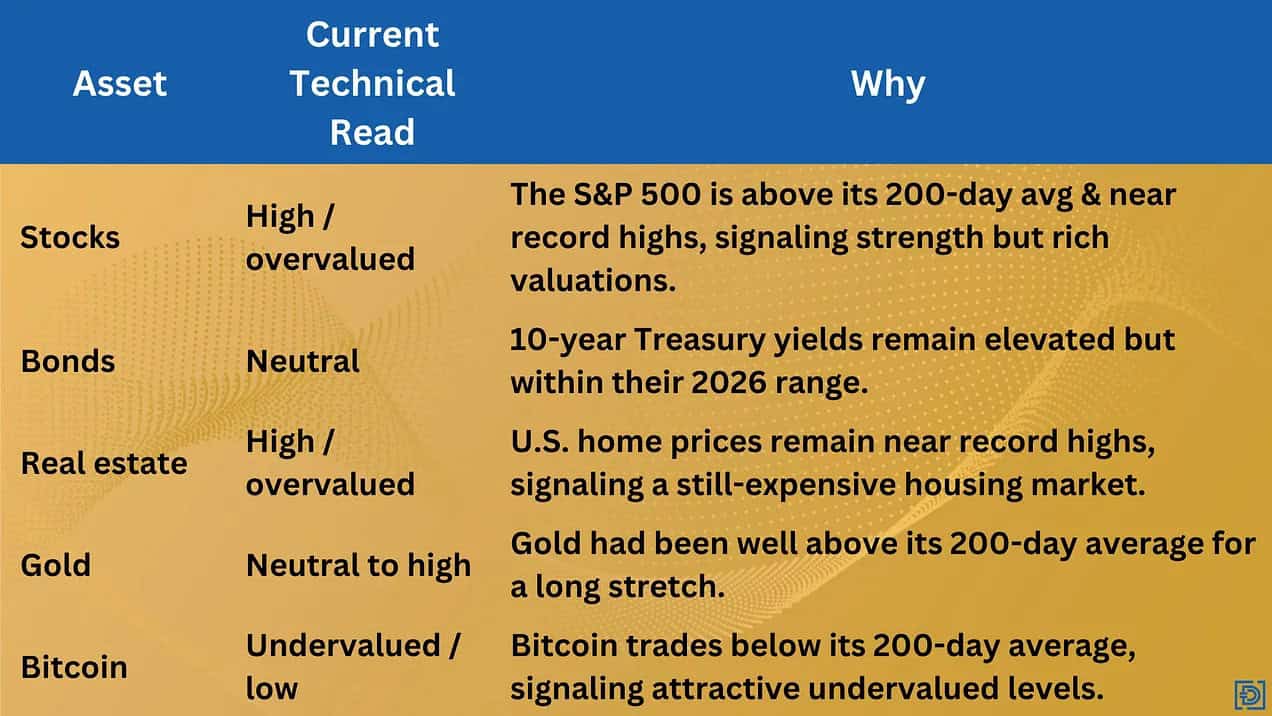
As we look across today’s investment landscape, many major asset classes continue to trade at historically elevated levels. U.S. equities remain near record highs, residential real estate prices are still hovering close to all-time highs, and gold has spent much of the past year well above its long-term trend. None of these conditions guarantee lower future returns, but they do suggest investors are paying premium prices for many traditional assets.
By comparison, Bitcoin stands apart. While sentiment toward bitcoin has weakened in recent months, the asset is currently trading below its 200-day moving average, a level often associated with periods of pessimism rather than euphoria. Historically, some of bitcoin’s most attractive long-term entry points have occurred when technical indicators reflected widespread caution instead of optimism.
This does not guarantee that bitcoin has reached its ultimate low, nor does it mean other asset classes cannot continue higher. When viewed alongside today’s elevated valuations in stocks, real estate, and other traditional assets, bitcoin appears to offer one of the more compelling risk-reward setups from a technical perspective.
That is why we remain cautious about selling bitcoin to chase the latest investment trend. Whether the excitement surrounds artificial intelligence today or another innovation tomorrow, disciplined investing is less about following headlines and more about allocating capital where expectations are lowest and potential opportunity is greatest.


Built And Operated In The USA 