“You own Bitcoin because you’re frightened of your physical security. You own it because you’re frightened of your financial security. The long-term fundamental reason you own it is because of the debasement of financial assets, because of deficits.”
- Larry Fink
Historically, that kind of price decline tends to trigger significant investor exits. When gold fell by a similar magnitude about a decade ago, roughly one third of investors exited their positions. That level of capitulation is considered normal behavior in traditional markets. What stands out in Bitcoin’s case is the relative absence of sustained outflows despite comparable pressure.
This resilience suggests that the investor base accessing Bitcoin through ETFs may be structurally different from prior cycles. Rather than reacting quickly to volatility, capital appears more patient and conviction driven. While daily flow data remains noisy, the cumulative trend points toward growing stability and longer holding periods.
If this pattern continues, ETF flows may become less useful as a short term trading signal and more important as a measure of underlying adoption. Persistent inflows, even at moderate levels, represent steady demand against a constrained supply backdrop. Over time, that dynamic could carry more weight than any single day’s flow data and signal a deeper shift in how Bitcoin is held within portfolios.

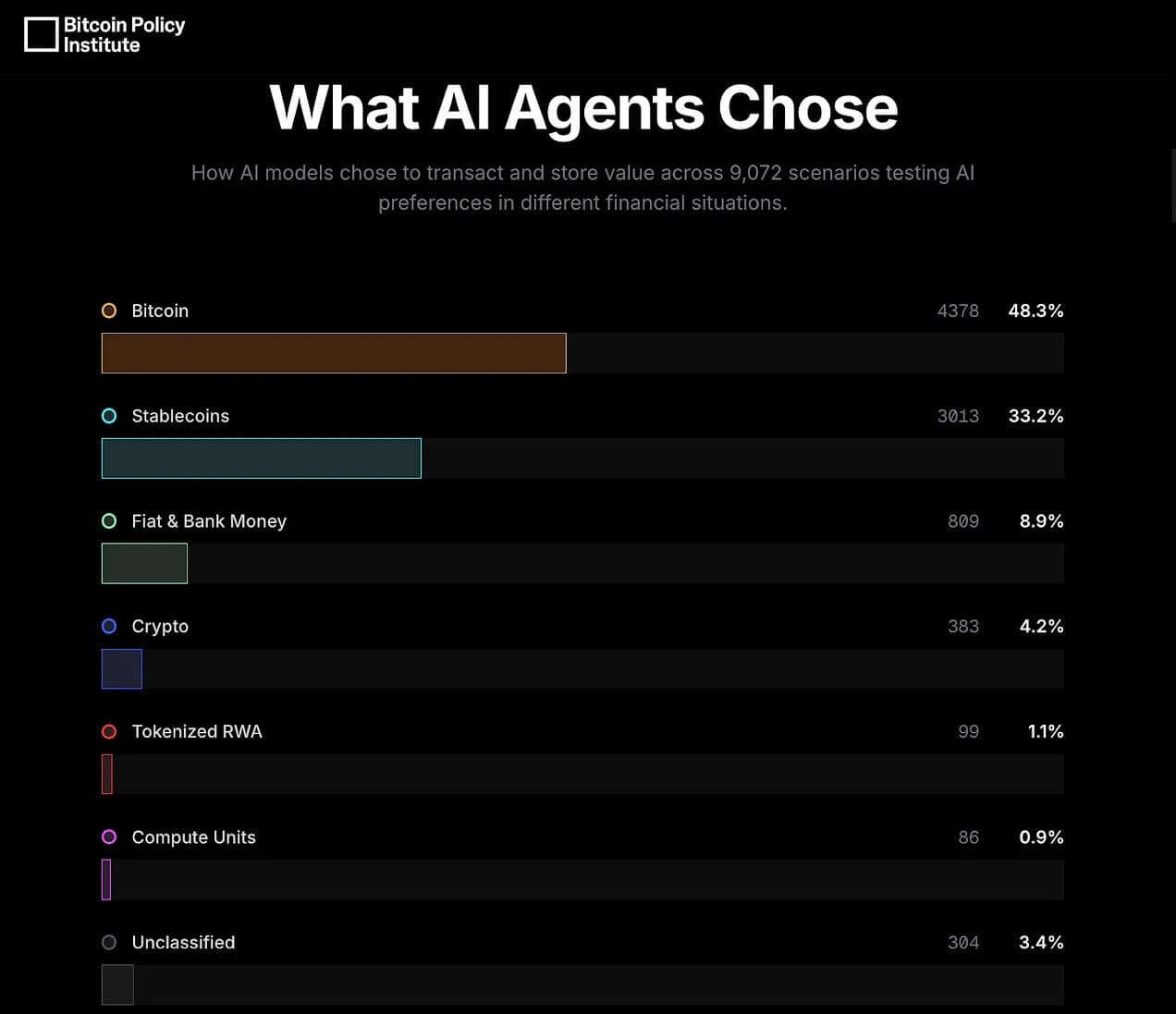
This directly reinforces what we outlined in last month’s issue. The infrastructure for “robot money” is already being built. Companies like Coinbase are enabling AI systems to connect directly to wallets and send payments, while Bitcoin’s Lightning Network allows agents to pay for APIs and data in real time using tiny fractions of a cent. Instead of subscriptions or billing cycles, machines can transact continuously, paying only for what they use.
The key constraint has never been demand, it has been the limitations of traditional financial rails. Banking systems require human identity, impose minimum transaction sizes, and struggle with speed across borders. These frictions make them incompatible with autonomous agents that operate 24/7 and transact at high frequency. Crypto removes those constraints by enabling instant, low-cost, and permissionless value transfer.
What the study makes clear is that this is not just a human narrative being imposed on technology. When AI systems are given the freedom to choose, they independently converge on the same conclusion. Bitcoin functions as savings, stablecoins function as money in motion, and both operate natively on open networks. The question we posed last month is starting to answer itself. It is not whether humans will adopt crypto for everyday payments, but whether machines already are.
Ethereum and Solana have been two of the most important platforms. Both ecosystems have matured significantly and now represent large, established parts of the digital asset market. As assets grow and mature, their upside potential typically becomes more moderate compared to earlier stage opportunities. That is a normal part of market cycles. Because of this, we are beginning to look toward emerging sectors that could drive the next phase of growth in the crypto market.
One area we are watching closely is decentralized finance, specifically the next generation of on chain trading, derivatives, and financial infrastructure. The first wave of DeFi focused on lending and simple exchanges. The next wave is focused on building full financial systems onchain, including derivatives, leverage, and more advanced trading platforms. This sector has historically produced strong performers in the later stages of bull markets. Projects to consider HYPE, JUP, DYDX.
Another area we are paying attention to is privacy. Privacy was one of the original use cases for cryptocurrency, but the sector has been quiet for several years due to regulatory pressure and exchange delistings. However, the need for financial privacy has not gone away, and the technology continues to improve. If the regulatory environment becomes clearer or adoption increases, privacy focused projects could see renewed interest later in the cycle. Projects to consider ZEC, XMR, SCRT.
Finally, we are monitoring real world asset tokenization and AI. As institutions and Wall Street continue moving into digital assets, the infrastructure that supports stablecoins, tokenized assets, and on-chain financial products could see significant growth. And we still think AI will have some major integration with crypto. Crypto moves fast, and in many cases, projects can frontrun their actual market fit. We saw this play out with early AI related tokens, including Artificial Super Intelligence (FET), where excitement and capital moved in ahead of real adoption. In hindsight, 2025 was more of a headfake for crypto AI than a true breakout. But AI will need a decentralized brain as the automation of everything movement takes place. The use case lends itself too much to crypto to not work in the long run. Projects to consider LINK, ONDO, WLD, TAO.
The crypto market is ultimately driven by capital rotation. Money does not flow into every asset at the same time. It moves from bitcoin to large caps, then from large caps into smaller sectors and new narratives. Understanding where we are in the cycle and where capital may flow next is one of the most important parts of portfolio management in digital assets.
Our strategy remains simple. Hold bitcoin as the core long term position. Look for select opportunities where other digital assets may outperform. Rotate those gains back into bitcoin over time. The goal is not to accumulate more dollars. The goal is to accumulate more bitcoin.
Bonds still play an important role in many portfolios. They can reduce volatility, provide income, and help stabilize a portfolio during equity market downturns. For investors who are risk averse or approaching retirement, bonds can still serve a purpose as the more stable portion of the portfolio.
Bitcoin serves a very different role. It is not designed to generate income or provide short term stability. Bitcoin’s role is long term appreciation and protection against currency debasement and monetary expansion. In many ways, bonds are designed to preserve purchasing power in the short term, while bitcoin is designed to preserve purchasing power over the long term. When viewed together, they are not necessarily competitors. They can actually complement each other inside a diversified portfolio.
There is also an interesting trend happening among self made business owners and entrepreneurs. Many of these individuals did not build their wealth by following conventional advice or relying on large institutions. They built wealth by taking calculated risks, maintaining control over their decisions, and betting on themselves. That mindset often carries over into how they think about investing.
For these investors, the appeal of bitcoin is not only performance. It is independence. Bitcoin operates on a permissionless network that is not controlled by a central bank, government, or single company. It cannot be diluted by increasing supply, and it cannot be easily frozen or restricted in the same way traditional financial assets can. For people who built their careers around self reliance and control over their own outcomes, this is not just an investment thesis. It is a philosophical alignment.
This does not mean bonds have no role, and it does not mean bitcoin is without risk. Bitcoin is volatile, the regulatory environment continues to evolve, and custody and security must be handled carefully. All of these are important considerations when building a portfolio. But for advisors and investors who are trying to understand why more high net worth individuals and business owners are allocating to bitcoin, the answer is often not just about returns. It is about diversification, independence, and long term purchasing power.
The conversation should not be bonds or bitcoin. The conversation should be how bitcoin fits into a portfolio that already includes stocks and bonds. The most important shift is moving from thinking about bitcoin as a speculative trade to thinking about bitcoin as a long term allocation within a well diversified portfolio.
More on crypto wealth management in our latest episode of Strategically held.

Built And Operated In The USA 