“The key to being a successful investor is to be aggressively patient.”
— Stan Druckenmiller
A useful comparison is gold. Gold ETFs have existed for more than two decades. Today, monthly inflows are relatively modest compared to bitcoin’s recent ETF launches. Yet gold has still doubled in price over the last several years. Price appreciation did not require accelerating inflows, only sustained ownership and limited available supply at the margin.
This is where bitcoin differs in an important way. Gold supply increases every year as new metal is mined. Bitcoin’s supply does not. Issuance is fixed and continues to decline over time.
As the market matures and inflows normalize, price becomes increasingly sensitive to small imbalances between supply and demand. With fewer new coins entering circulation and a growing base of long-term holders, bitcoin can move higher even on lighter inflows.
The risk is not that inflows slow. The risk is focusing on flows instead of structure.
From a portfolio construction standpoint, the logic is increasingly compelling. Bitcoin has shown low to neutral long-term correlations with broad commodity baskets, while gold remains more closely linked to bonds and traditional commodity exposures. For multi-asset portfolios that already own gold, energy, and industrial metals, bitcoin is increasingly evaluated as part of the “real asset” or “inflation hedge” allocation rather than as a technology proxy.
Market behavior reinforces this framing. During periods of geopolitical stress, strength in gold prices has often coincided with positive short-term performance in bitcoin, while oil’s influence has been weak or insignificant. This suggests that a growing segment of investors already group bitcoin mentally alongside hard assets.
The primary friction is structural. Commodity allocators typically operate within benchmarks and mandates that do not yet include bitcoin. Adding exposure requires governance changes, not just a trade. As benchmarks evolve and mandates are updated, the most realistic outcome is not a wholesale exit from commodities, but a steady reweighting where a portion of gold and commodity exposure migrates toward bitcoin through ETFs and mandate-compliant structures.
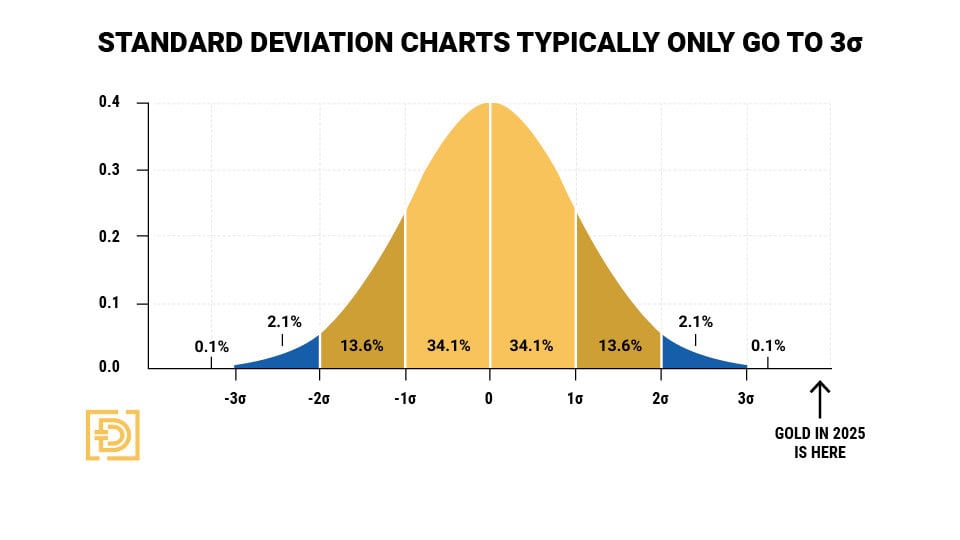
Gold’s recent move adds pressure to this process. Gold’s volatility (and its price) recently hit extreme highs and was found to be trading ~4 standard deviations above its long‑term average in late 2025. A standard deviation chart shows how much a set of values, such as prices, typically vary from their average. In a normal distribution, roughly 16% of outcomes occur more than one standard deviation above the mean, about 2.3% occur above two, and nearly all observations (about 99.7%) fall within three standard deviations of the mean. Moves beyond three standard deviations are rare and often prompt portfolio review and rebalancing discussions rather than incremental buying.

The scale of standard deviations:
Moves of this magnitude do not tend to last and degree of price reversion is almost certainly expected. If it does, and to what extent remains to be seen. Regardless, gold doesn’t have to fall significantly for bitcoin to benefit. But when positioning and expectations become stretched, investors must reassess diversification and forward-looking return potential. For portfolios that already hold significant gold exposure but little or no bitcoin, that reassessment increasingly includes bitcoin.
Even modest reallocations are meaningful. A 2 to 5 percent shift from gold into bitcoin over several years would represent tens of billions of dollars in potential flows from this cohort alone. With post-halving bitcoin supply remaining thin, even incremental, rules-driven capital can have an outsized impact on price.
The documentary Birthgap explores the drivers behind this trend and reaches a counterintuitive conclusion. Declining birth rates are not primarily caused by war, cultural liberalization, or people choosing more leisure. The dominant factor is economic stress. Periods where everything feels more expensive, including housing, education, and healthcare, create uncertainty. That uncertainty leads families to delay or forgo having children altogether. Over time, that mindset compounds and is passed down to the next generation.This matters because governments increasingly understand what another major recession would mean in a world already facing demographic decline. A shock like 2008, layered on top of falling birth rates, does not just damage the economy in the short term. It risks permanently impairing future population growth and labor force participation.
As a result, the policy response is changing. When population growth slows and neutral interest rates fall, governments lose the ability to rely on organic economic expansion. Stimulus becomes the default tool, not the emergency one. Fiscal expansion, monetary accommodation, and more centralized economic management are no longer optional. They are necessary to keep the system functioning.
In that environment, assets that cannot be inflated become increasingly valuable. Bitcoin sits at the extreme end of that spectrum which makes it the most valuable asset. It has a fixed supply, is globally liquid, and operates outside the control of any government or central bank. As policymakers lean more heavily on stimulus to offset demographic decline, the purchasing power of fiat currencies is steadily diluted.
For long-term investors, this makes bitcoin less a speculative asset and more a form of structural insurance. A growing number of individuals, institutions, and even governments are responding the same way. They are allocating consistently, holding through cycles, and treating bitcoin as a long-duration asset rather than a short-term trade.
In a world defined by declining birth rates and permanent economic intervention, owning bitcoin is not about timing markets. It is about positioning capital in an asset that cannot be debased, cannot be bailed out, and does not require population growth to work.
Michael Soroudi has earned the CFP® certification, congrats to him. We look forward to adding more value to our clients through expertise in crypto strategies and long-term financial planning. Read more here: https://www.daim.io/trending-item/a-cfp-professional-joins-our-team-to-strengthen-bitcoin-financial-planning

Built And Operated In The USA 