Then it failed. Spectacularly.
Fast forward to today, and the crypto landscape has matured in many ways. But a new form of groupthink has taken its place: the bitcoin treasury strategy. That is, companies, especially public ones, are raising debt or equity to accumulate bitcoin on their balance sheets under the belief that BTC’s long-term upside justifies the capital allocation.
At DAiM, we’re long-term bitcoin believers. But conviction should not lead to complacency. The parallels between Terra’s collapse and today’s BTC-on-balance-sheet movement offer important reminders.
In both cases, a belief in the strategy’s strength can obfuscate a weakness because risk management is replaced by narrative conviction. It was true for Terra and we will see how it plays out for these treasure
Terra’s ecosystem functioned as long as everyone believed the peg would hold. When doubts arose, UST holders rushed for the exit. That triggered a hyperinflationary loop in LUNA that broke the system in a matter of days. Despite BTC reserves, the model was fundamentally fragile because it relied on market psychology and the assumption that yield would keep capital in place.
The bitcoin treasury trend is gaining steam. MicroStrategy, miners, and other firms have made it clear that bitcoin is their core strategic asset. Some even borrow or issue equity to buy more.
The risk isn’t in owning bitcoin itself. It’s in how the asset is acquired and held.
Leverage introduces vulnerability in a volatile asset class. Issuing equity to buy BTC only makes sense if BTC significantly outperforms your share price. And when a company’s stock price becomes tightly correlated with bitcoin, negative feedback loops can emerge. A falling BTC price can lead to lower equity value, which limits fundraising options and reduces the capacity to accumulate more BTC, compounding downside exposure.
To put it differently, if a company borrows at 8 percent to buy BTC and BTC goes sideways or down, shareholders absorb the loss. Unlike sovereign nations or long-term holders, public companies are accountable to short-term markets and investor expectations.
At DAiM, we help clients invest in bitcoin within a clear, risk-aware framework that we transparently share with each of our clients. That includes using qualified custodians and regulated accounts such as IRAs, trusts, and brokerage accounts. We avoid leverage or risky “yield” schemes, proactively rebalance intelligently during volatility, and focus on bitcoin’s role as long-term, censorship-resistant property, not just a speculative asset.
Bitcoin does not need to be rescued by capital markets. It wins in the long run on its own merits. As fiduciaries, our role is not just to believe in bitcoin. It is to help clients navigate the right way to own it, without taking on unnecessary structural risk.
2022 was a wake-up call. It is important we do not hit snooze.
Ripple also touches on another cognitive bias that we see in many crypto investors, called unit bias. Unit bias causes crypto investors to look at what one particular token costs rather than the market value of the token supply which provides a more accurate picture of how much an asset can appreciate in the future. In the case of XRP, many people see the token cost at only $3 and think that $1,000 or even $10,000 is extremely achievable. They think bitcoin is at $115k and ETH is at $3700 so XRP is extremely undervalued on a per token basis. The more important number to look at is total market cap. Market cap is a function of supply and current market price of the token. If you look at bitcoin there are about 19.9 million bitcoin in circulation at a current market price of $115,000. That makes the market cap about $2.2 trillion. XRP is at $3 a token with a circulating supply of about 60 billion. So its market cap is $3/token x 60B tokens or $180B. If XRP were to realistically get to $10,000/token that would put its market cap at $600 trillion. Keep in mind that this doesn’t factor into the supply that the Ripple team holds and could dump on the market. Anyway, back to market cap. $600T is equivalent to a bitcoin price of over $30,000,000 per coin. Additionally, the two largest publicly-traded companies, Nvidia and Microsoft, have market caps around $4T. So the amount of capital it would take to move the price of Ripple to a valuation 150x greater than the two largest companies in the world is so massive that we don’t see it as a realistic outcome.
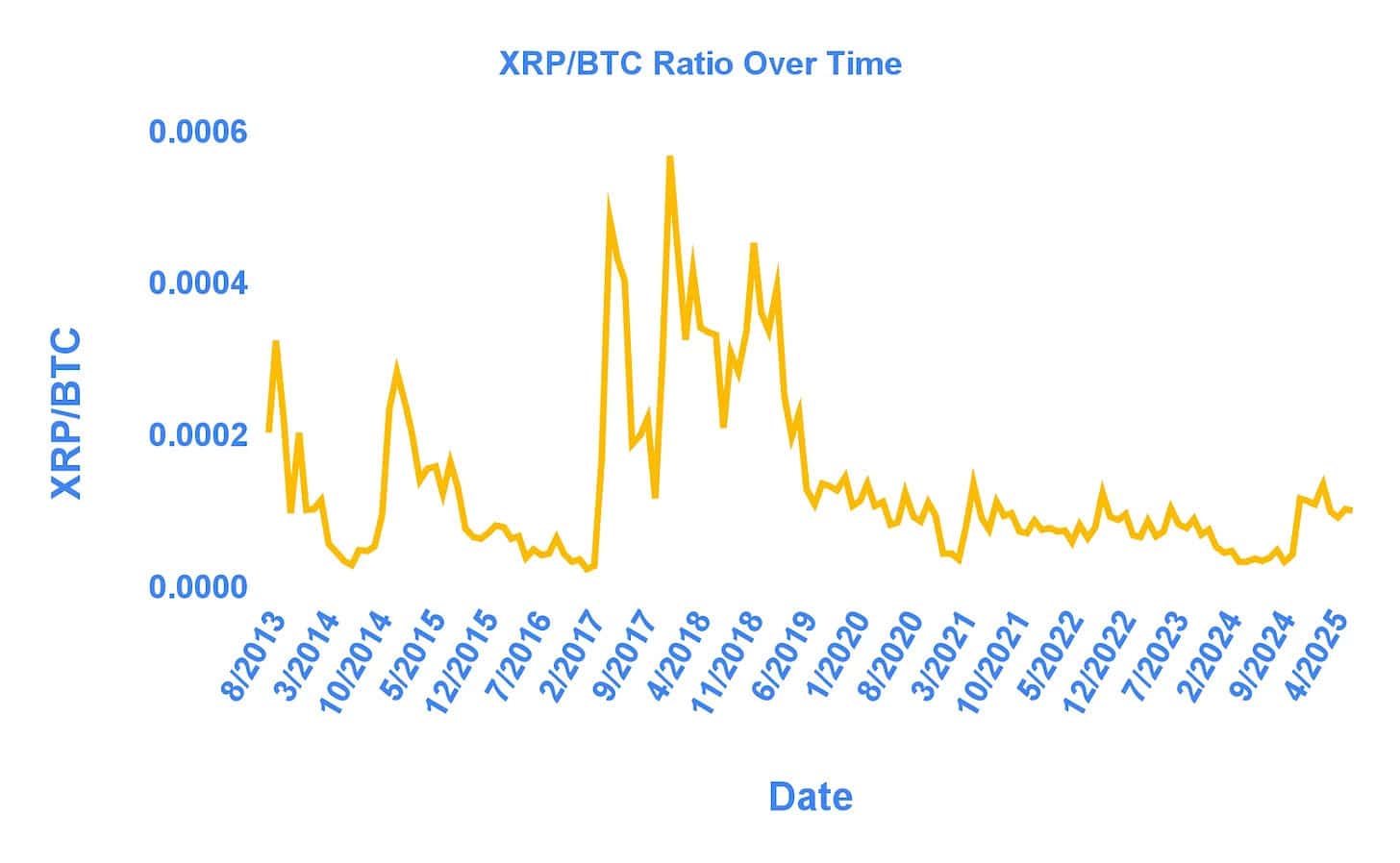
If you like XRP and want to hold it as part of a diversified portfolio, that is fine but we strongly feel it should be a small allocation relative to the bitcoin you hold. Keep in mind that XRP pumps every few years and outperforms bitcoin in small bursts. But the price action has never been maintained over long periods. Look at the historical xrp/btc ratio below.

The goal in crypto investing should be to stack sats (add more bitcoin to your portfolio). Allocating away from bitcoin is a strategic decision that can help you achieve this goal. However, from our experience, it should be done with extreme discipline. First, you only need about 5-10% portfolio allocated to altcoins to meaningfully take advantage of outperformance relative to bitcoin. Also, as you can see from the chart, these periods of outperformance are short-lived. Our feeling is that the opportunity to capture XRP outperformance this cycle happened in the run up from November to now. If you held XRP at $0.50 and still do, you can swap your XRP for about 4x as much bitcoin as you could have 8 months ago. That’s an offer we recommend taking 100 out of 100 times.

Built And Operated In The USA 