For years, Google Search has been the front door to the internet, especially for those trying to learn about complex topics like crypto. From “what is bitcoin” to “best crypto wallets,” the search engine has long dominated how people explore this new financial frontier. But recently, a quiet shift is underway. Search volumes for many crypto-related terms are declining. Is interest fading? Not quite. People aren’t searching less, they’re just searching differently.
Enter large language models (LLMs) like ChatGPT, Claude, Grok, and Gemini. These tools are becoming the default way people learn about crypto, replacing Google for many use cases. Unlike traditional search engines that return a flood of links, LLMs deliver clear, contextualized answers without ads, clickbait, or SEO games. Ask how to custody your bitcoin, or whether Ethereum is inflationary, and you’ll get a concise, direct answer written in plain English.
This is a major shift in behavior. Newcomers to crypto aren’t going down the rabbit hole of forums and YouTube anymore. They’re starting with AI. Investors, founders, and even financial advisors are turning to tools like ChatGPT for everything from market overviews to protocol comparisons to tax planning with digital assets. Even Google has noticed. Its new Search Generative Experience (SGE) integrates AI-powered summaries, effectively acknowledging that users want synthesized answers, not just links. Meanwhile, platforms like OpenAI’s ChatGPT now boast hundreds of millions of users and continue to grow rapidly.
Not all search terms are equally affected. People still search for token tickers, prices, and exchanges, but informational queries are increasingly being handled by AI. These include:
In the past, these queries would lead users down a trail of blog posts, Reddit threads, and SEO-stuffed articles. A lot of time was wasted reading just to get an answer. Today, LLMs offer the same information in seconds, more clearly and without the noise. For crypto educators, wealth managers, media outlets, and builders, this presents both a challenge and an opportunity.
As search behaviors evolve and AI-driven interactions reshape how users seek information, these tools may struggle to capture the full spectrum of genuine market interest. Investors should approach these outputs with caution. We look forward to seeing and using new tools that incorporate AI-powered sentiment analysis to stay ahead in the dynamic crypto landscape.
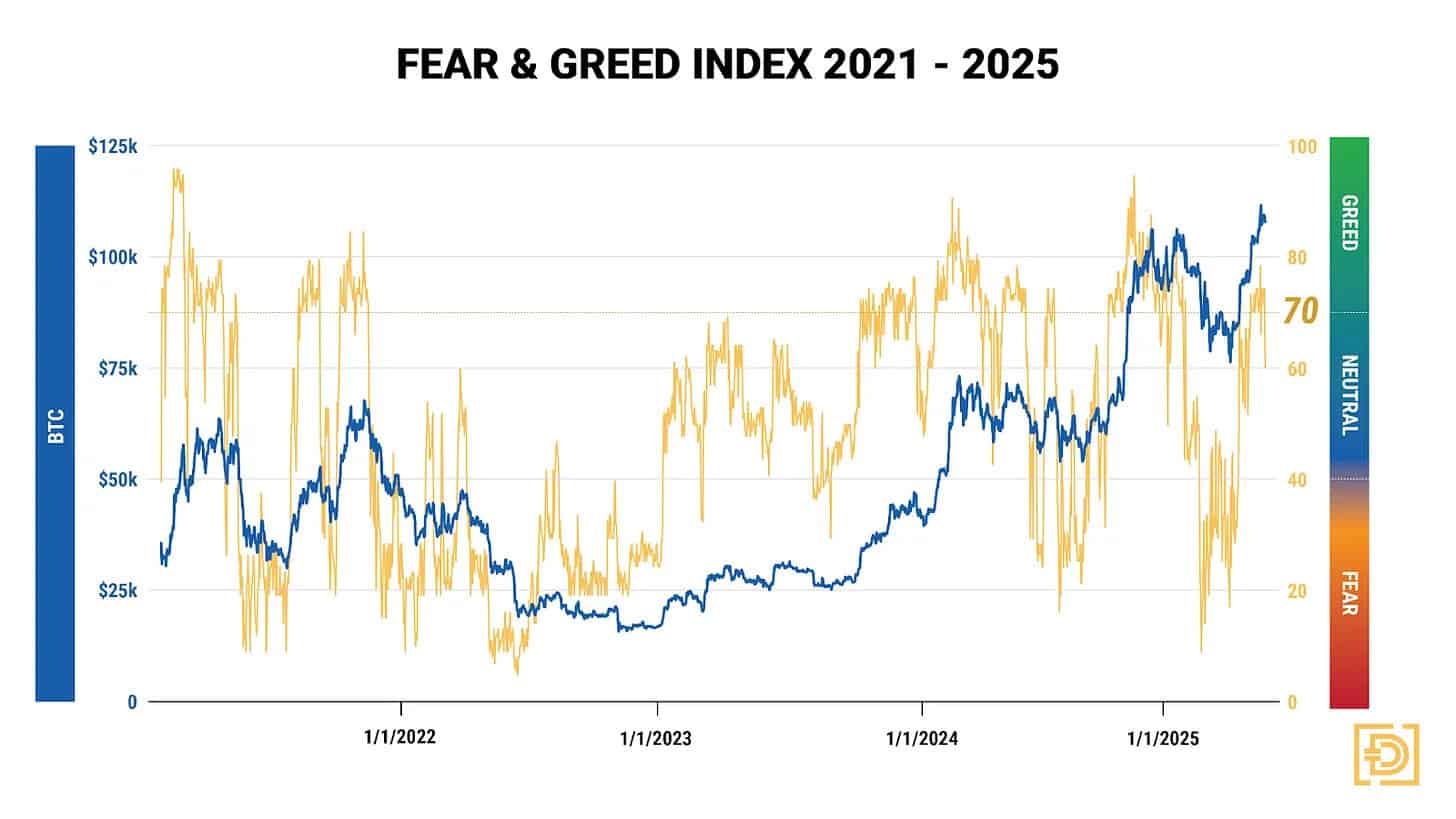
While investors are increasingly relying on AI they still appreciate traditional data and charts. One popular metric that gauges crypto interest and emotion is the Fear and Greed Index. Bitcoin makes strong moves and evokes strong emotions. It doesn’t just move, it surges, crashes, and rebounds in ways that can rattle even seasoned investors. To help make sense of the emotional swings in the market, many turn to the Fear & Greed Index. This tool attempts to quantify investor sentiment on a scale from 0 (extreme fear) to 100 (extreme greed), reflecting factors like volatility, volume, social media activity, dominance, and search trends. 10% of the F&G Index input comes from Google search data, not LLMs, which could change going forward.
Intuitively, the index aligns with price movement. Fear shows up when bitcoin is trading well below its recent highs, often following a sharp drop. Greed appears when bitcoin is rallying, especially after periods of consolidation or low volatility. But sentiment isn't just about direction, it’s also about duration. We wanted to understand not just when market euphoria sets in, but how long it typically lasts.
We looked at data from January 2021 through May 2025, specifically tracking periods when the index rose above 70, a threshold that suggests sustained investor optimism. We found that when the index breaks above 70 and stays there for more than three days, it tends to remain in the “greed” zone for an average of 46 days.

That’s significant. It means that once sentiment turns euphoric, it often stays that way for a month and a half, not just a quick spike and drop. This observation runs counter to the assumption that greed is always immediately followed by a crash. In fact, many of bitcoin’s strongest rallies have occurred during prolonged stretches of high greed.
However, it’s important to keep the index in perspective:
In our view, the most consistent path to strong returns has been holding bitcoin across full cycles, not trying to time emotional inflection points. As the chart below shows, greed can accompany major moves upward but the biggest gains have gone to those who stayed invested regardless of sentiment.
This month, the Department of Labor (DOL) quietly reversed course on one of its most controversial positions: its 2022 guidance that discouraged 401(k) plans from offering cryptocurrency exposure. For those of us who’ve spent years building compliant, crypto-forward retirement plans, it’s a long overdue shift.
In 2022, the DOL issued Compliance Assistance Release 2022-01 (CAR 2022-01), a nonbinding document that strongly cautioned plan sponsors against offering crypto investments. While it wasn’t a formal ban, it had the same chilling effect. The message was clear: include bitcoin in a retirement plan, and expect regulatory heat.
And that heat was real. DAIM served as a 3(38) fiduciary advisor to 401(k) plans with spot bitcoin exposure beginning in 2021. We were subject to a DOL examination that lasted nearly two years. An exhaustive review with no findings, no recommendations, and no enforcement. Just a lot of time, stress, and uncertainty for everyone involved.
The DOL’s stance, while perhaps well-intentioned, did real damage. It deprived thousands of everyday workers of the opportunity to invest in bitcoin when it was trading in the low $1,000s. Participants were stuck with the same old mix of target-date funds and stock/bond portfolios, while one of the best-performing assets of the past decade sat off-limits.
For a policy that claimed to protect investors, it ended up hurting those with the least access to diversified investment options. The recent reversal isn’t being shouted from rooftops, but it doesn’t need to be. The message is clear: crypto is no longer off-limits in 401(k) plans. The door is now open for plan sponsors to revisit digital asset offerings without fear of regulatory retaliation.
We believe this is a necessary step toward financial modernization. Real diversification means offering exposure to alternative assets, especially bitcoin, which offers a unique set of properties unmatched by traditional asset classes.
This policy shift validates what we’ve known all along: offering bitcoin in retirement accounts can be done responsibly, compliantly, and with fiduciary care.
Here is a chart from our flagship 401(k) portfolio that is included in the plans we advise.

As you can see, adding 10% of bitcoin to a broadly diversified mix of mutual funds is extremely beneficial over long holding periods. The mutual funds reflect a standard 60/40 (stock/bond) retirement portfolio. By simply rotating 10% of bonds into bitcoin, an employee generated 8% of alpha annually going back 5 years. Assuming a modest contribution and conservative forward returns, this portfolio construction is projected to generate an employee several hundred thousand dollars that they likely wouldn’t have had in retirement.
As this market evolves, we expect more advisors, plan sponsors, and recordkeepers to re-engage with crypto, not because it’s trendy, but because it’s what a modern retirement plan should offer.
If you're a business owner, plan sponsor, or advisor interested in bringing bitcoin into your retirement offerings, we can help. The barriers have fallen. Now is the time to act.


Built And Operated In The USA 